Archive for the ‘Shravana Masa’ Category

Chakrabja Mandala – ಚಕ್ರಾಬ್ಜ ಮಂಡಲ

Our Guru Sree Madhvacharya has explained in his Tantrasara that “ಪೂಜ್ಯಶ್ಚ್ಹ ಭಾಗವನ್ ನಿತ್ಯಂ ಚಕ್ರಾಬ್ಜಾ ಮಂಡಲೇ”. In English “Poojyascha Bhagavan
nityam chakraabjamandale”.  Worshiping the Almighty Lord with  Chakrabja Mandala – ಚಕ್ರಾಬ್ಜ ಮಂಡಲ as a pedestal or peetha is very rewarding.

So, what is the meaning of Chakrabja Mandala – ಚಕ್ರಾಬ್ಜ ಮಂಡಲ?

  • Chakra means wheel
  • Abja means Lotus in Sanskrit and
  • Mandala is the frame work

I had learnt to draw this when I came to the US several years back from my Brother-in-law Balaji’s ( my sister Suma’s husband) grandmother who was here in the US.

However, due to several reasons this rangoli had completely skipped my mind and I forgot drawing this. During the Shravana Masa, my Little Niece Shwetha, you all know her right? The one who drew our beloved Raghavendra Swamigalu had drawn this for Sree Anantha Padmanabha Vrata. My Sister showed it to me when I visited her house for the festival.

You can see the picture Shwetha has drawn in the picture below, I have a red/yellow arrow pointing to the same. There are two, one exactly below the table, and the other can’t be seen since the God is on top of the rangoli.

IMG_0860

I came back home and started searching the drawing online, to find none. Accidentally I opened the “ಸಾಧನ ದೀಪಿಕಾ  or Sadhana Deepika” book I had, and there it was the Rangoli. It is customary to draw this while performing pooje, and than place the Lord or any God you are performing pooje on top of this rangoli.

I will post a step by step instruction on how to draw this Chakrabja Mandala – ಚಕ್ರಾಬ್ಜ ಮಂಡಲ soon. For the time being attached below are images of the same.

1. This image is from my “ಸಾಧನ ದೀಪಿಕಾ  or Sadhana Deepika” book.

chakramandala2

2. This image is from SBAT temple. Details of the temple can be found here. Scroll down in the page, and you will see several images.  http://sbat.org/Poojas_Homas.html.

chakramandala1

Sree Krishnastami Pooja @ 14619

This year we celebrated Krishnastami with great joy. Like most of you know, we were not able to perform any festival last year. The joy of performing the festival along with the visit of my Daughter Sneha was really satisfying. As soon as we finished the festival, we left to “The Bahamas” on Friday early morning for a vacation along with our daughter. We returned back yesterday, so we could perform the Annual Death Anniversary of my Father-in-law today.  I planned the timing so we could have a break and also not miss any of our festivals or rituals which is very important to us.

So, attached below are some details about the festival, the food items I prepared. Thanks for everyone who shared their wonderful experiences about the festival.

I started with detailed Rangoli in our front door.

I fasted completely on this day, and my Daughter helped in performing so many of the items listed below. So, I made the following items for our beloved Krishna. My Husband always makes Om Pudi, which is a tradition he likes to follow since his Father also always made Om Pudi for our Little Krishna.

1. Moong Dal Kosambari – ಹೆಸರು ಬೆಲೆ ಕೋಸಂಬರಿ

2. Channa Dal Kosambari – ಕಡಲೆ  ಬೆಲೆ ಕೋಸಂಬರಿ

3. Sweet Avalakki – ಸಿಹಿ ಅವಲಕ್ಕಿ

4. Mosaru Avalakki – ಮೊಸರು ಅವಲಕ್ಕಿ

5. Upma – ಉಪಿಟ್ಟು

6. Kesari Bath – ಕೇಸರಿ ಬಾತ್

7. Coconut Burfi – ಕೊಬ್ಬರಿ ಮಿಟಾಯಿ

8. Kodubale – ಕೋಡುಬ

9. Chakali – ಚಕ್ಲಿ

10. Om Pudi – ಓಂ ಪುಡಿ

11. Rave Unde – ರವೆ ಉಂಡೆ

12. Besan Unde – ಬೇಸನ್ ಉಂಡೆ

Lots of fruits, Coconut, Butter and flowers.

Sree Krishnarpana Mastu.

I will soon post the recipe for Coconut Burfi, Kodubale and Chakali. This Chakali recipe was different from the one posted earlier.

Shri Krishna Janmashtami/Krishna Jayanthi – August 9th 2012

ಕೃಷ್ನಯ ವಾಸುದೇವಾಯ
ದೇವಕಿ ನಂದ  ನಾಯಚ
ನಂದಗೋಪ  ಕುಮಾರಾಯ
ಶ್ರೀ  ಗೋವಿಂದಯ ನಮೋ  ನಮಃ

ಕೃಷ್ಣಯ ವಾಸುದೇವಾಯ  ಹರಯೇ  ಪರಮಾತ್ಮನೇ
ಪ್ರಣತ ಕ್ಲೇಶ  ನಾಶಾಯ  ಗೋವಿಂದಾಯ  ನಮೋ ನಮಃ

KRISHNAYA VASUDEVAYA
DEVAKI NANDA NAYACHA
NANDAGOPA KUMARAYA
SRI GOVINDAYA NAMO NAMAHA

KRISHNAYA VASUDEVAYA HARAYE PARAMAATMANE
PRANATHAH KLESHA NAASHAAYA GOVINDAAYA NAMONAMAHA

Pooje performed in 2009…

P8130061

P8130069

P8130083

P8130079


Updates: Pooje at my residence on August 23rd 2008.

Preparation 1

Preparation 1

Closeup of Lord's idols

Closeup of Lord

Another look before pooje

Another look before pooje

After the Pooje

After the Pooje

After the Naivedya

After the Naivedya

Shri Krishnastami is celebrated on Thursday August 9th 2012. Sri Krishnastami or Krishna Jayanthi marks the celebration of the birth of Lord Sri Krishna;the eighth avatar of Lord Vishnu. Lord Sri Krishna was born on the ‘Rohini’ nakshatra on Ashtami; that’s why it is called Krishnastami. In karnataka it is also known as Gokulashtami and Janmashtami. The festival occurs between August and September in our English calendar.

According to our Hindu mythology, Krishna was born to destroy Mathura’s demon King Kamsa, brother of his virtuous mother, Devaki. A celestial voice told Kamsa that he would be killed by the eighth child of Devaki. Alarmed by the message, Kamsa imprisoned Devaki and her husband Vasudeva. Taking no chances, Kamsa went on killing Devaki’s children soon after birth. Lord Krishna was born as the eighth child of Vasudeva at midnight. But at Krishna’s birth, under divine instructions, Vasudeva left the prison unnoticed with the baby. He crossed the mighty river Yamuna which was in spate due to heavy rains. Without any difficulty, he walked across the river protected from rain by the mighty serpent Shesha, and reached Gokul. In Gokul, on the same midnight, a girl named Yogamaya had been born to Yasoda, wife of Nanda a herdsman. The babies were exchanged, and Vasudeva came back to prison with the girl. When Kamsa was told that his sister had given birth to a child, Kamsa attempted kill the child. But the baby who was Goddess Maya, flew off to the heaven, warning Kamsa that Krishna, who would kill him, had already been born and was alive. Eventually, Krishna killed Kamsa, and released his parents from the prison, and brought peace and happiness to the common people.

In our Madhwa tradition, we are supposed to fast on this day, and late during the night; usually midnight we are supposed to give Arghya to Lord krishna. Here is the stotra to be said while giving Arghya to Lord Krishna. While giving the Arghya, hold a coin, a lemon and dried date in your right hand, and using a silver spoon offer 3 times milk and 3 times water to Lord krishna in a silver bowl, and keep repeating the below Stotra as well. Everyone in the household has to give Arghya to the Lord.

Argya Stotra

Arghya Stotra

Arghya Stotra from the Utharadi Matta Panchanga

Arghya Stotra from the Utharadi Matta Panchanga

Krishna Arghya

Jathaha Kamsavadarthaya Bhoobharotharanayacha|
Kouravanam Vinashaya Dhaityanam Nidhanaya Cha ||
Pandavanam Hitharthaya Dharamasamsthapanaya Cha|
GruhanaArghyam Maya Dhatham Devakya Sahitho Hare ||

Chandra Arghya

Kshirodharnava Sambhootha AthiGotraSamudhbhava |
GruhanaArghyam Maya Dhatham Rhohinya Sahitho Shashin ||

Another set from Prasanna.

Krishna Arghya mantra
jatah kamsavadharthay bhubharo harNayacha

kouravaNam vinashaya diatyanam nidhanaya cha
panDavanam hitarthaya dharma sansthapanay cha

grahaNaarghyam mya dattam devikya sahito hare||

chandra arghya
kshirodarNav sambhootham atrigotra samudbhavam
grahaNrghyam mya dattam rohiNya sahitah shashinah||

The food items performed are mostly sweet dishes, fried items and items with Avalakki. All these dishes are performed with extreme madi. If you are not able to do so, here are some useful tips:

1. The most important thing in any festival is the breaking of the coconut and offering it to god, so bring a coconut.

2. Keep also 5 fruits for offering to god, like Banana, Mango, Apple, Orange, Grapes, Plum, Pear and so on..

3. You can make the following dishes which have been mentioned here in the blog which need no cooking at all, add the seasonings after you do the Naivedaya to god.

4. If you don’t mind cooking on the gas stove, here are other recipes you can make as well

5. Bring lots of flowers which are again easily available; roses

6. Offer butter also to the Lord which again is available in all grocery stores.

7. Below are several links which has all the songs in praise of Lord Krishna posted in this blog.

8. Here are some links from dvaita.org as pdf files

9. We also place a silver cradle and keep the Ambegalu Krishna idol in the cradle and rock the cradle while singing the following song:

10. Recite Om Namo Bhagavate Vasudevaya as many times as possible.

11. Little feet of Lord Krishna are drawn as well along with other rangolis.

11. Last but not the least, do as many namaskaras as you can and break the fast.

Once you finish the pooje, surrender yourself to the Almighty Lord by saying the following Stotra.

ಕಾಯೇನ  ವಾಚ ಮನಸೇನದ್ರಿಯಿರ್ವ
ಬುದ್ಧ್ಯತ್ಮನ  ವ  ಪ್ರಕೃತೆ  ಸ್ವಭಾವತ್
ಕರೋಮಿ  ಯದ್ಯಥ್   ಸಕಲಂ  ಪರಸ್ಮೈ
ಶ್ರೀಮಾನ್ ನಾರಾಯಣಯೇತಿ ಸಮರ್ಪಯಾಮಿ

KAYENA VACHA MANASENDRIYAIRVA
BUDDHYATMANA VA PRAKRITE SWABHAVATH
KAROMI YADYAD SAKALAM PARASMAI
SRIMAN NARAYANAYETI SAMARPAYAMI

May Lord Krishna Bless ALL

ಶ್ರೀ ಕೃಷ್ಣರ್ಪನಮಸ್ತು

Sree Raghavendra Swamy Celebration @ 5th Block Jayanagar

My Sister-in-law Radha, has sent the picture from 5th block Raghavendra Swamy mutt. It is unbelievable to see the picture. Tears rolled down my eyes. May our beloved Rayaru bless one and all. Thanks Radha.


Upakarma(Rigveda and Yajurveda) – August 2nd 2012

Upakarma is one of the ancient Vedic rituals practiced to date by every Brahmin. It is done once a year, during Shravana Masa- which is usually in August or September. The main activity performed in an Upakarma is the changing of the Janivara or Holy Thread. This year the dates are as follows:

August 2nd 2012 – Rigveda Upakarma, Yajurveda Upakarma and Raksha Bandhan. Check your local panchanga to find out the exact date.

Did you know that Upakarma means “Beginning” in Sanskrit.

Now that we have all the details for the Upakarma, how about Raksha Bhandan? Raksha” means protection, “bandhan” means bound or binding. During this festival brothers and sisters show that they care for each other; include your cousins also. A sister will tie the rakhi, which is made of thread around her brother’s right wrist, usually with flowers attached to it. In return, her brother will give sweets, or money to show that they will love and protect them.

As with any other festival, there are many legends for this festival as well.

1. In ancient times a woman tied a ‘rakshaa’ on her husband’s wrist to protect him from evil. Later, she tied a ‘rakshaa’ on her brother’s right wrist, to protect him from evil influence and those factors which may taint his character, and to strengthen the bond of sibling love between them.

2. Vishnu helped the wife of Indra, to aid her husband in his battle against the demon Bali. Bali had driven Indra out of heaven. Vishnu gave Indra’s wife a silk thread to put on Indra’s wrist as a lucky charm. It enabled him to defeat Bali and regain his kingdom.

3. During the battle of Mahabharat,Queen Kunti tied a raksha on her grandson Abhimanyu to protect him in battle.

P.S: Those of you residing in the Washington DC area, Sri Siva Vishnu Temple is celebrating the ceremony in the morning. You can get all the details from the SSVT site and check the August newsletter for the timings to perform the same.

Aishwarya Patra Rangoli – ಐಶ್ವರ್ಯ ಪಾತ್ರ ರಂಗೋಲಿ

For the greatest Lakshmi pooja, Sree VaraMahalakshmi I have practiced and finally learnt how to draw the Aishwarya Patra rangoli. I have drawn this using Microsoft Paint. As soon as I have the picture drawn for the pooje, I will post that as well. But here are the details for this which many many of you have asked for.

Draw dots in the following sequence on both sides.

1. 7 dots

2. 8 dots opposite to the 7 dots

3. 7 dots

4. 6 dots

5. 3 dots

See image below:

Next, join the inner most dots, as shown below:

Join the outermost lines,

Join on the other sides.

Keep joining all the loose ends as you see below:

And finally you should have:

Like I said, I drew this 7-8 times before I could actually get it right. So, practice does help.

Shri Vara Mahalakshmi Vrata – July 27th 2012

Shri Vara Mahalakshmi Vrata is performed by married Hindu women to seek the blessings of the Goddess Mahalakshmi, wife of Lord Vishnu.

The Vrata is observed on the Friday immediately preceding the full moon day of the month of
Sravana Masa. On the day of Pooje or Vrata, women clean their homes and decorate their front yards with rangolis. Later, they take a bath and deck wear pure silk saree and jewellery. The lady performing the pooje makes a mandala with the drawing of a lotus upon it. A kalasha filled with rice and topped with fresh mango and betel leaves, a coconut smeared with haldi and kumkum and cloth are placed on the mandala and Lakshmi is invoked therein.

After the worship of the kalasha, follows the worship of Ganesha, then the worship of the sacred thread. Now the main worship of Vara Lakshmi begins and the scared thread is worshipped a second time. It is then tied to the right hand of the lady. After the worship thamboola is given to 5 married ladies.

The same evening, we invite all the neighboring ladies(married women) and offer them tamboola; also called veeledele Adike, which is an offering of betel leaves, fruits, betel nuts, kumkum, haldi and dakshine. At this point the ladies also sing songs in praise of goddess Varalakshmi.

Attached below is a scanned vrata procedure in Kannada:

So, here comes the link which has the lyrics for all songs posted on this blog on Goddess Lakshmi.

And here comes the link which has colorful and many designs for drawing Rangoli

And can any festival be complete without authentic dishes? Here are some recipes posted in this blog:

Attached is the post link for the links I have for lyrics, and Shravana Friday Pooje procedure.

P.S: As always no food is prepared with onion or garlic.

Shri Vara Mahalakshmi Vrata pooje at Chandrika’s house three years back.

Shri Vara MahaLakshmi Vrata 1

Shri Vara MahaLakshmi Vrata 1

Updated: Sampat Shukravarada Haadu – Lakshmi Song

Update: Just today, I recorded the song for this. Please ignore some mistakes I made. It is a song for almost 19 minutes, so there was no time to record the same more than once. It is recorded just for your reference. I have recorded exactly like my Mom sings, Thanks MOM.

Sampat Shukravarada Haadu

This is called Sampat Shukravarada Haadu. It has to be sung after performing Lakshmi Pooja in the evening on 5 Friday’s during Shravana Masa.

The book I had is in Kannada, and was given to me by my Mom. It is very old. Some of the pages came out a little blur. Forgive me for that. It has 26 pages and 119 paragraphs.

You can listen to the song online here. Link provided by Rashmi.

Shravana Masa Lakshmi Pooja Vidhana – July 20th, 27th & August 3rd and 10th

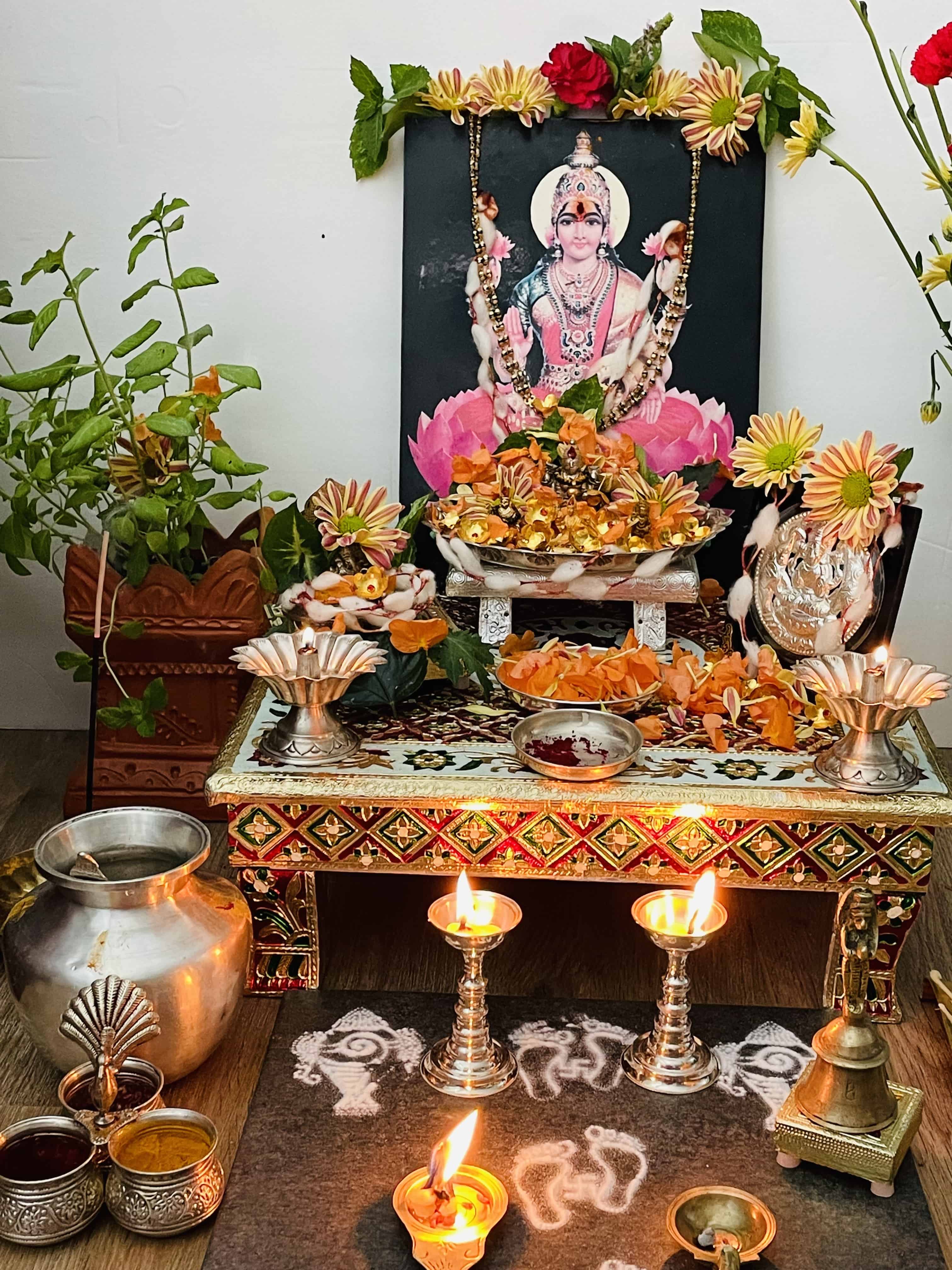
Evening Lakshmi Pooja on 7/20/2012.

Rangoli designs for the Pooja, with Lakshmi Hrudaya.

A picture of jasmine garland made from flowers in my own garden for Lakshmi Pooja.

Pooja begins with lamps, flowers, Gejje Vastra:

After, Naivedya, Mangalaruthi, and Laskhmi Aarathi.


Shravana Shukravara Lakshmi pooja is performed on all the Friday’s. This year it is performed on July 20th, 27th & August 3rd and 10th.

I have scanned and attached a document which has the complete details on performing Sri Lakshmi Pooja during Fridays and also Shravana Masa. This shouldn’t be confused for Sri VaraMahaLakshmi Vrata. I will post a separate post providing all details for Sri VaraMahaLakshmi Vrata.

This document has all the details from doing the Achamana, to Sankalpa, Dhyana, Naivedya, and Maha Mangalarathi.

It is a PDF document and is in Kannada.

Attached below are other links posted here on Goddess Lakshmi.

Attached below are some other links where many more posts have been added on Lyrics and Goddess Lakshmi.

P.S: It is very difficult to translate these in English, so I am not doing that. If you have any book and want to share, scan it and send it to me.

Pooja Sankalpa in Kannada & English

Now that the festival season is approaching, it is important to start the pooja’s the right way. Attached is a link I found where you can find the complete reference for doing sankalpa. Please fill in the blanks like these for this year:

ನಂದನ  ನಮ  ಸಂವತ್ಸರೇ- Nandana Nama Samvatsara

ಭಾರತಕಂಡೆ – bharathakande or if you are residing outside India, the name of the country

ವರ್ಷ ಋತು – varSha Rutau

ಶ್ರಾವಣ ಮಾಸೇ – Shravana Mase

ಕೃಷ್ಣ ಪಕ್ಷೆ- Krishna Pakshe

And than based on the Hindu calendar fill in the  ತಿಥಿ  Tithi, ವಾರ day and ವಾಸರೆ
your Surname.

Hope this helps. Let me know if you have any doubts.

Ok, here is the link for the site which has the details.

Scribd.com

A million Thanks to the person who posted this online.

Follow

Get every new post delivered to your Inbox.

Join 617 other followers

%d bloggers like this: